Acrylic Nails and Ingrown Toenails: Causes & Prevention
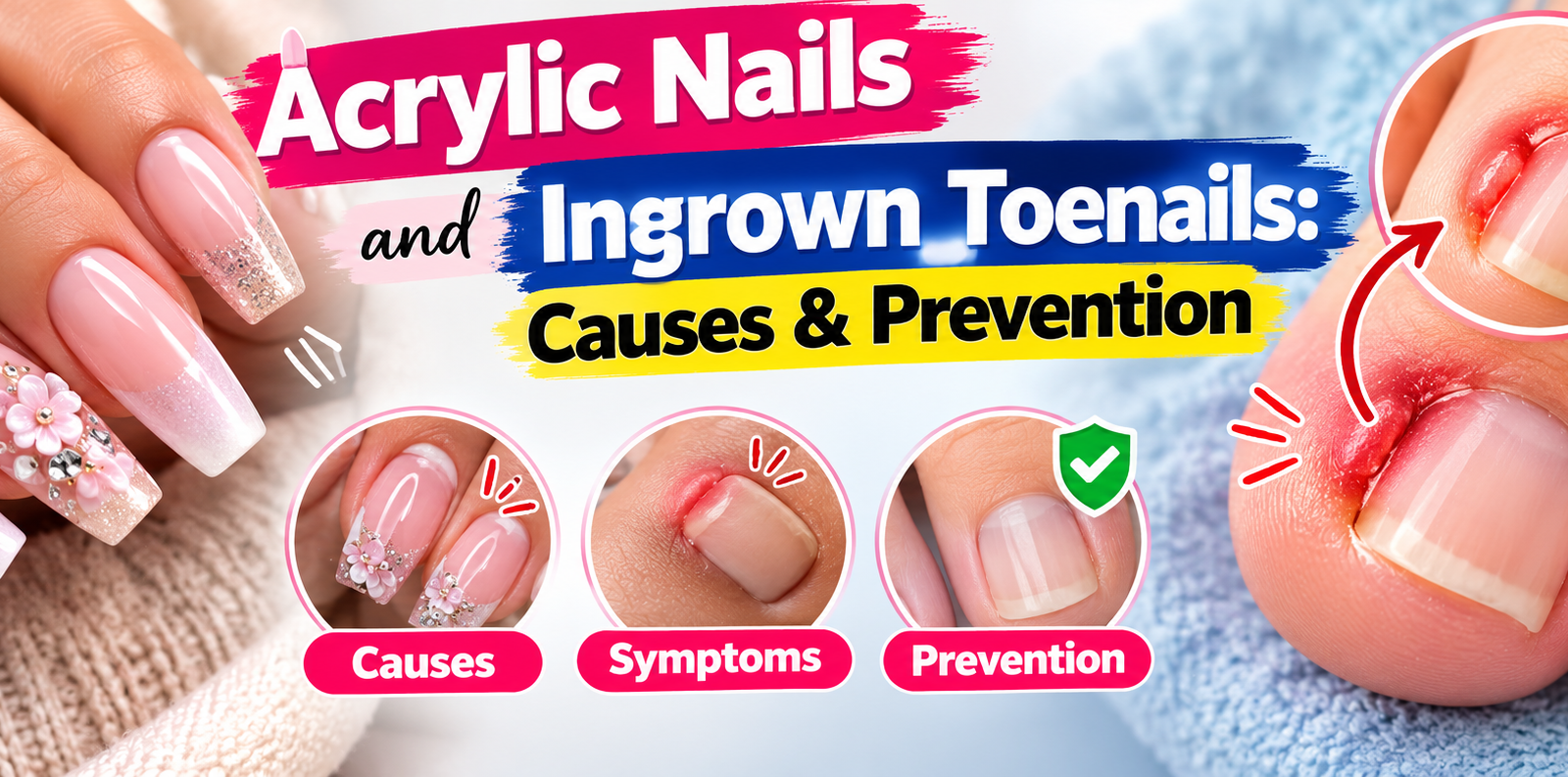
An acrylic overlay may make an ingrown toenail look smoother, but it doesn’t correct the nail edge or surrounding skin causing the problem. Extra thickness can increase pressure, trap moisture, conceal infection, and make professional treatment more difficult. If the affected toe is already covered, don’t add another layer or try to pry, drill, or cut the product off.
Seek prompt care if there is spreading redness, pus, severe pain, fever, numbness, or tissue that looks black. Even without those warning signs, a covered or recurrent ingrown toenail should be examined rather than treated cosmetically.
The quick answer
Acrylic nails cannot fix an ingrown toenail. The condition is mechanical: part of the toenail has grown into, or is pressing against, the adjacent skin. Adding a rigid product over it may disguise the uneven edge, but it doesn’t move the nail back into a normal growth path or relieve the tissue caught beneath it.
For a mild, recently started case, the usual first step is to leave the natural nail uncoated, keep the area clean and dry, reduce rubbing pressure, and have a podiatrist or other qualified foot clinician assess it. Persistent, painful, infected, or recurrent cases need professional treatment. Cosmetic nail work should wait until the toe has healed and the ingrown nail no longer needs close monitoring.
The NHS ingrown-toenail guidance also emphasizes appropriate nail cutting, suitable footwear, and medical review for painful or infected nails.
What people mean by “acrylic nails for ingrown toenails”
The phrase can describe several different things. Most are cosmetic products rather than medical treatments.
| Method | What it is | Why it usually doesn’t fix an ingrown toenail |
|---|---|---|
| Full-coverage acrylic overlay | A layer of acrylic placed over part or all of the natural nail | Adds thickness but leaves the nail edge in the same position against the skin |
| Sculpted acrylic toenail | Product shaped and extended over the entire toe | Can increase pressure and make trimming and inspection more difficult |
| Acrylic “repair” | A small amount of product used to cover a split, cracked, or uneven nail | Supports the surface without correcting abnormal growth or pressure |
| Peel-on or false toenail | A preformed artificial nail attached with glue or adhesive | Can lift, trap moisture, and pull at fragile or inflamed tissue |
| Acrylic built into a channel | A curved or hollow area created beneath product to guide the nail | A superficial channel is not the same as a professionally fitted brace or medical gutter |
| Gel or composite overlay | Similar enhancement, but made from a different product | It isn’t acrylic, but the same concern applies: covering does not fix an embedded nail edge |
Acrylic nail systems are designed primarily to strengthen or decorate healthy nails. They are not designed to treat infection, remove an embedded nail edge, or change the structure of the nail bed. General guidance on DIY nail-building techniques can be useful for healthy fingernails, but it should not be applied to an ingrown toenail.
A true ingrown toenail can involve the nail’s curvature, the shape of the toe, surrounding pressure, skin folds, previous trauma, or repeated trimming errors. The solution depends on which factor is causing the problem. A cosmetic shell treats none of them.
Why people consider covering an ingrown toenail
It’s easy to understand the appeal. A thick, smooth overlay can hide a ragged nail edge, cover discoloration, and make the toe look more even under a sandal. Someone may also be preparing for an event and want a quick cosmetic fix before arranging medical care.
That goal is understandable, but it delays the part that matters. An ingrown toenail can worsen while the underlying nail continues pressing into irritated skin. The longer it stays covered, the harder a clinician may find it to assess the injury and remove the product safely.
Some people also hope the acrylic will become a new, stronger nail surface that “grows over” the defect. It won’t. A false or enhanced nail does not control how the natural nail grows.
If the nail edge remains embedded, the problem can still cause pain even when the top looks smooth.
How acrylic can make an ingrown toenail worse
Added thickness and pressure
A rigid layer can make the nail plate thicker without correcting its sideways pressure. Every step can then transmit more force to the inflamed skin. A full-cover design may also hold the folded skin against the nail.
The product doesn’t need to touch raw tissue to cause a problem. Tight buildup, an uneven underside, or an edge that moves during walking can create repeated pressure.
Trapped moisture and reduced visibility
A covering reduces the visible skin around the nail. Early redness, swelling, drainage, or a split in the skin may be harder to notice. Moisture can collect beneath the enhancement, particularly after socks and shoes trap sweat.
This doesn’t mean an ingrown nail always causes infection. It means the cover can make an existing infection easier to miss and may make daily care less effective.
Filing and sharp edges
Some technicians thin the nail, shape the sidewalls, or create space beneath the product. A small filing job on a healthy nail is routine. Deep filing beside an ingrown toenail can instead thin the nail unevenly, create a sharp edge, damage the nail bed, or pull on swollen tissue.
Using a drill-free method may reduce heat and vibration, but it does not make aggressive filing of an ingrown nail safe. General advice on filing without a drill is not a substitute for treating the affected sidewall.
Removal can create new trauma
Home removal can snag the natural nail, pull living skin, or tear an area that has become adherent to the product. Soaking and acetone can also dry or irritate injured tissue. If acrylic is attached to the skin or the toe is painful, pulling it off is especially likely to worsen the injury.
A salon tech may consider a file-and-soak removal harmless, but that assumption does not account for a nail edge embedded in inflamed tissue. Professional removal should be slow and controlled, with the toe protected from further pressure.
Chemical irritation and allergy
Skin contact with uncured acrylic product can cause irritation or allergic contact dermatitis. A person may develop intense itching, burning, redness, or a rash around the nail. Infection and allergy can look similar from a distance, which is another reason to have the toe examined rather than simply covering it again.
A thick, airtight layer is also not a treatment for either reaction.
Who should not try an acrylic overlay
In many cases, the affected toenail should be left natural until a clinician has assessed it. Avoid cosmetic enhancement when any of the following apply.
An infected or open toenail
Signs of infection can include:
- Increasing pain, redness, warmth, or swelling
- Yellow, green, or cloudy drainage
- Crusting
- A bad odor
- A spreading red streak
- Fever or chills
- A wound that is no longer healing
Antibiotic ointment or a topical product may not solve the mechanical problem. If the skin is open, infected, or draining, covering it can allow the area to remain wet and make evaluation harder. A podiatrist or other appropriate clinician should examine it.
Diabetes, neuropathy, or poor circulation
These conditions change the risk substantially. Reduced sensation can allow a nail or shoe to cause repeated pressure without much pain. Diabetes can slow wound healing, while peripheral arterial disease reduces circulation to the foot.
An infection may spread more quickly, and poor healing can turn a small nail injury into a serious wound.
Someone with diabetes should not use acrylic to hide an ingrown nail or attempt to treat it at home. Even a small break in the skin deserves prompt professional assessment.
A nail that is repeatedly becoming ingrown
One mild episode is different from a nail that becomes ingrown every few weeks. Recurrence may involve a very curved nail, a wide toe, a deep side fold, trauma, fungal changes, or another structural issue. A cosmetic overlay will not address the pattern.
A clinician can decide whether nail-bracing, a gutter, removal of part of the nail edge, or another approach is more appropriate.
Severe pain or repeated injury
If the toe hurts with light pressure, bleeds when the nail edge moves, or prevents normal walking, the problem is no longer suitable for a purely cosmetic workaround. Do not keep thickening the nail to compensate for pain.
A child or anyone unable to report changes
Children may outgrow some mild cases, but ongoing pain, redness, or drainage should still be assessed. A child who cannot accurately describe the discomfort needs conservative, professionally guided care rather than a trial of thickened product.
What to do if the ingrown toenail is already covered
The safest response is to stop adding product and avoid trying to remove it in a way that could injure the toe.
1. Do not cut, drill, peel, or pick at the product
Trying to create a “relief gap” with a blade, rotary tool, nail file, or household tool can cut living skin or deepen the nail injury. Do not cut a notch into the edge of the product either. A temporary gap may put more force on the swollen sidewall.
If the artificial nail is attached to the skin, leave it alone. Pulling it away can tear the skin or nail plate.
2. Keep the toe clean and dry
Wash the affected area gently with soap and clean water, pat it dry, and dry between the toes. If the skin is open or draining, a clinician should guide the care because harsh disinfectants can irritate exposed tissue.
Do not repeatedly soak a painful, infected toe in salt, eucalyptus, alcohol, or peroxide solutions. These treatments may feel strong but can damage fragile tissue without correcting the nail edge.
3. Reduce rubbing pressure
Wear roomy footwear that does not press on the toe. Change out of wet socks, especially if you spend much of the day in shoes. A clean, nonadherent gauze can protect a draining area from the inside of a sock, but it should be changed when damp or soiled and must not wrap tightly around the toe.
Don’t rely on adhesive tape, rubber bands, or a tight bandage to pull the skin away. These can increase pressure or hold moisture against the injury.
4. Stop trimming toward the painful area
Avoid trying to “catch” or remove the embedded edge. If you cut too deeply, the nail can become shorter at the sides, making the next growth cycle more likely to curl inward.
General advice about safe length reduction for healthy artificial nails should not be used on an ingrown toe.
5. Arrange an in-person assessment
A podiatrist, foot and ankle specialist, or other clinician experienced in toenail problems should assess the toe. Tell them what product was used, how long it has been in place, whether you have removed any layers, and whether there is redness, drainage, fever, or spreading pain.
If adhesive has touched intact skin, follow safe cosmetic-adhesive removal guidance such as lifting glue from surrounding skin. Injured or painful tissue calls for more caution and less aggressive chemical or mechanical removal.
When an ingrown toenail needs urgent care
The symptoms below should not be managed with more nail product.
| Finding | Why it matters | What to do |
|---|---|---|
| Pain and redness spreading beyond the toe | May indicate an expanding soft-tissue infection | Seek same-day medical care |
| Pus, foul odor, or worsening drainage | Suggests infection around or beneath the nail | Have the nail examined promptly |
| Fever or chills with an infected toe | May suggest the infection is no longer limited to a small area | Seek urgent medical care |
| Severe, rapid, or throbbing pain | Can indicate infection, an abscess, or significant tissue pressure | Seek same-day care |
| Black, gray, or dusky tissue | May signal impaired blood flow or damaged tissue, especially with circulation problems | Seek urgent assessment |
| A cold or numb toe | May suggest compromised circulation or nerve function | Seek urgent assessment |
| Inability to bear weight or walk normally | The nail or surrounding skin may be significantly injured | Obtain prompt in-person care |
| Any open wound with diabetes or poor circulation | Healing may be slow and infection can become serious | Contact a clinician the same day |
A mild case without spreading redness, drainage, fever, or severe pain can usually wait for a routine podiatrist appointment, but it should not be ignored if it keeps recurring.
What professional treatment may involve
Treatment depends on the cause and severity. It does not automatically mean surgery.
Initial examination
The clinician will look at the nail shape, the amount of skin trapped underneath, signs of infection, the surrounding swelling, and whether circulation and sensation are normal. They may also ask about diabetes, neuropathy, vascular disease, previous injuries, and earlier episodes.
The existing artificial covering may need to be removed before the nail can be evaluated properly.
Gentle nail care
A mild, noninfected case may be managed by trimming the nail appropriately, reducing pressure, cleaning the area, and addressing footwear or structural issues. A qualified professional may sometimes lift a small amount of the embedded edge or use a drainage path.
This is a procedure, not a DIY task. Excessively cutting the nail corner can cause the problem to return more severely.
Gutter, brace, or orthotic device
A plastic gutter, flexible brace, or custom orthotic can sometimes direct nail growth away from the skin. The device must fit the nail and toe and may need periodic adjustment. A curved channel sculpted into cosmetic acrylic is not automatically a medical gutter.
Evidence for conservative devices varies, so they are most useful when selected and supervised by a clinician. DIY taping and improvised braces can pull or trap the tissue.
Partial nail edge removal
Recurrent or persistent cases may require removal of part of the nail edge. The clinician may also treat the matrix, the growth-producing area, to reduce recurrence. A procedure can relieve pressure more reliably than a gutter, although healing and recurrence depend on the specific technique and the underlying cause.
Infection management
A clinician may recommend or prescribe antibiotics when surrounding soft-tissue infection is present. Antibiotics usually do not correct the nail shape or remove an embedded edge on their own. Topical or oral medication should not be started or applied under the product without appropriate guidance.
Safer alternatives to an acrylic ingrown-toenail fix
The best alternative to covering the nail is to treat the mechanical problem and reduce pressure.
| Alternative | Main purpose | Important limitation |
|---|---|---|
| Leave the affected nail natural | Allows it to be seen, trimmed, and treated | It may not look cosmetically smooth while healing |
| Proper nail trimming | Removes pressure without making the side too short | Technique matters; cutting into the corner can worsen the problem |
| Roomy footwear and moisture control | Reduces repeated pressure and maceration | May not solve a curved nail or deep skin fold |
| Clinician-fitted gutter or brace | May help guide growth in selected cases | It requires selection and monitoring |
| Partial edge removal or matrix treatment | Relieves the embedded edge and may reduce recurrence | It is a medical procedure performed by a qualified clinician |
| Cosmetic enhancement after healing | Meets appearance needs without concealing active disease | It should begin only after the nail and skin are fully settled |
Keep the natural nail visible
A clear view of the nail and surrounding skin is more useful than a smooth but misleading covering. Check the sidewalls each day for worsening redness, swelling, warmth, drainage, or a skin break. Keep the relevant toe dry and avoid putting nail polish over an area you need to monitor.
Use a professional brace or gutter
A brace or gutter can be considered for a mild or recurring ingrown nail after a clinician evaluates the toe. It must support the nail without pressing on inflamed tissue. Instructions for dressing an ingrown toenail found online can vary, and forceful taping can worsen swelling or infection.
Diabetes, neuropathy, or poor circulation makes home DIY methods even less suitable.
Consider clinical treatment for repeated cases
If the nail has already needed removal more than once, do not keep trying temporary cosmetic fixes. A professional can assess whether conservative care is likely to work or whether partial edge treatment would give a more reliable result.
Delay cosmetic nails until the problem is inactive
Once the skin is fully healed, the nail is growing normally, and the toe is no longer painful, it may be reasonable to consider a light cosmetic finish. Even then, keep the sidewalls visible and stop using the enhancement if rubbing, redness, or lifting occurs.
A proper product should be applied by someone who understands the distinction between a natural enhancement and a damaged toe. Reviews of professional acrylic products may help a reader understand cosmetic systems, but none should be presented as a treatment for an ingrown toenail.
Safe care for the affected toe
Trim conservatively
When the nail is healthy and easy to clip, cut it fairly straight across. Avoid digging into the sidewalls or making the corners extremely short. Shorter side growth can give the nail more room to curve into the skin.
Do not repeatedly cut a thin, ragged edge just because it keeps catching on socks. If the nail is uneven or the toe is painful, let a professional handle the trimming.
Choose footwear that reduces pressure
Wide-toe-box shoes are useful. Avoid pointy toe boxes, narrow shoes, high heels that crowd the toes, and footwear that bends the toe so sharply that the nail presses into the side. Lace shoes more loosely, switch to roomy sandals or slippers around the home, and replace worn footwear that crowds the fifth toe.
If the toenail curves inward because of the toe’s shape, no pair of shoes may be enough. Persistent pressure deserves an assessment.
Control moisture
Change socks daily and whenever they become damp. Breathable socks and shoes help reduce maceration. Dry between the toes after bathing, and pay attention to the space beside the ingrown nail rather than only the top of the toe.
Long, wet or sweaty conditions can soften skin and increase the friction that contributes to irritation. They do not correct the nail edge, but moisture control makes the surrounding tissue easier to assess and treat.
Avoid self-directed products
Do not apply household glue, cyanoacrylate sold outside cosmetic use, gel, resin, or sculpting material to trap the edge in place. These products can irritate skin, make removal harder, and conceal infection. A thicker barrier may feel protective for a few hours but does not provide a reliable treatment.
Similarly, do not place a blade under the nail to remove tissue. A painless cut can turn into a bleeding wound, and the bleeding may make subsequent treatment more complicated.
Special care for high-risk feet
Diabetes
Diabetes raises the stakes because nerve damage can hide pressure, circulation may be reduced, and wounds can heal slowly. An ingrown toenail should be assessed rather than managed with cosmetic buildup.
Someone with diabetes should also tell the clinician about any numbness, burning, color change, or slow-healing cuts elsewhere on the foot. A small nail problem can become more significant when sensation or blood flow is impaired.
Peripheral neuropathy
Neuropathy does not mean discomfort is harmless. A nail can dig into the skin, shoes can rub, and infection can progress without a strong warning signal. Inspect the toes regularly and do not rely on pain to decide whether a wound needs care.
Poor circulation
Reduced circulation makes infection treatment and wound healing more difficult. Thickening a nail does not improve blood flow. A cold, dark, pale, numb, or painful toe needs prompt evaluation.
Immune suppression
People taking immune-suppressing medicines or living with conditions that affect immunity should seek early care for a broken or infected nail. Less familiar signs, such as subtle swelling or increasing discomfort without dramatic pain, still deserve attention.
Blood thinners
People taking anticoagulants or medicines that affect bleeding should tell the treating clinician before any minor procedure. They should not cut, puncture, or drain the toe themselves.
How to reduce the chance of another ingrown nail
After the current problem is treated, focus on pressure and trimming rather than trying to rebuild the nail cosmetically.
- Trim the nail straight across and do not cut the sidewalls too short.
- Change wet socks and avoid shoes that pinch or crowd the toe.
- Inspect the nail if you have diabetes, neuropathy, poor circulation, or a history of recurring problems.
- Do not round the nail into the sidewall with a file or cosmetic tool.
- Address a painful thick nail with a foot clinician instead of repeatedly shaving it at home.
- Let the sidewalls and surrounding skin remain visible while healing.
- Seek care for a nail that is increasingly curved, widening, thickened, or repeatedly catching.
- Choose a pedicurist who will stop if the toe shows open skin, infection, or a clearly embedded nail edge.
A healthy natural nail will not be perfectly straight. The goal is to keep it long enough and shaped so its edges do not press sharply into the skin.
Choosing a podiatrist or nail professional
A nail technician may be able to trim and care for a healthy toenail. They should not be expected to diagnose an infection, perform toe surgery, prescribe medication, or manage a high-risk foot. Scope and rules vary by location.
For a painful, recurrent, infected, or medically complicated nail, choose a podiatrist, foot and ankle specialist, or other clinician with the appropriate training. Ask:
- Will the existing cosmetic covering be removed safely before treatment?
- Can you assess the nail bed, skin fold, circulation, and signs of infection?
- Is this case more suitable for conservative care, a fitted gutter or brace, or a minor procedure?
- What is the plan if the nail becomes more infected after the covering is removed?
- What should be monitored during healing?
Be cautious of anyone who promises a permanent cure without examining the nail or who suggests applying more product to “make room.” A genuine assessment should explain why the problem happened and how the plan prevents further injury.
Common mistakes and myths
| Mistake | Why it is a problem |
|---|---|
| “The acrylic will grow over the ingrown edge.” | The enhancement cannot change the natural nail’s growth path. |
| “More product protects the toe.” | Added thickness can increase pressure and make the nail edge harder to see. |
| “If it doesn’t hurt, it is fine.” | Neuropathy, early infection, or reduced circulation can reduce pain while injury continues. |
| “A thick channel redirects the nail.” | A cosmetic channel may not relieve the skin fold and can create new pressure. |
| “I can drain it at home.” | Draining can spread infection or damage the nail bed without fixing the source. |
| “I can use antibiotic ointment.” | An ointment is not a substitute for removing the mechanical cause and may hide early infection. |
| “I can pull off the overlay.” | Removal can tear skin, lift the nail, or increase bleeding and swelling. |
| “Recurring ingrown nails are only a cosmetic problem.” | Recurrence may reflect a curved nail, pressure, trauma, or another structural issue. |
| “A nail file will release the nail.” | Deep filing can create sharp edges, thin the nail unevenly, or injure living tissue. |
| “I’ll deal with it after the event.” | Delayed care can turn mild irritation into an infected wound, especially in high-risk feet. |
Frequently asked questions
Can acrylic nails fix an ingrown toenail?
No. Acrylic can cover or change the appearance of the nail, but it cannot correct an edge that is pressing into the skin. It may hide redness or drainage and can increase pressure or complicate removal.
The underlying nail and surrounding tissue need to be assessed and treated separately.
Can I cover an ingrown toenail with gel, fake nails, or nail glue instead?
It is not a good idea. These products can trap moisture, pull at swollen skin, or conceal infection. A gel overlay is not acrylic, but the same mechanical concern applies.
If the toe is already open, draining, or increasingly painful, leave it uncovered and get it evaluated.
Should I remove the acrylic at home?
If the product is painful, attached to the skin, or hiding redness, swelling, or drainage, do not remove it yourself. Soaking, acetone, blades, files, and pliers can cause additional injury. A professional should remove the covering and examine the nail underneath.
Is warm-water soaking useful?
A gentle clean soak may soften intact skin and make the toe more comfortable, but it does not remove an embedded nail edge. Do not use harsh salts or chemicals on broken tissue, and do not soak repeatedly in place of treatment. A draining or infected toe needs professional care.
Does antibiotic ointment treat an ingrown toenail?
Usually not. The problem is often a nail edge pressing into skin rather than an infection that can be cleared from the surface. Antibiotics may be needed when there is surrounding infection, but they should be used under medical guidance and do not replace treatment of the mechanical cause.
Can a nail technician cut the ingrown edge?
A technician should not perform a medical procedure or treat an infected toe unless qualified and legally permitted to do so. Ordinary nail trimming on a healthy nail is different from removing an embedded edge. A person with an infected or recurrent nail needs a podiatrist or other appropriate clinician.
When can I get a cosmetic acrylic nail again?
Wait until the toe is fully healed, the nail is growing normally, and there is no redness, drainage, tenderness, or broken skin. If the toenail has been repeatedly ingrown, ask the treating clinician whether cosmetic thickening could increase pressure again. A lighter, removable finish may be safer than a thick full-cover extension.
Is an ingrown toenail an emergency if it hurts but has no drainage?
Severe or rapidly increasing pain still needs prompt assessment. Same-day care is warranted if the pain is severe, the toe is becoming red or swollen, the nail is bleeding, or walking is difficult. Seek urgent care for spreading redness, pus, fever, numbness, a cold toe, or dark tissue.
What should I do if I have diabetes or poor circulation?
Leave the ingrown nail uncoated and contact a podiatrist or medical clinician promptly. Do not cut it, drain it, or use adhesive products. Reduced sensation can hide pressure, and reduced circulation can slow healing or increase infection risk.
Can I put a bandage over it for the day?
A clean, nonadherent dressing may protect a draining toe from socks and reduce friction. It should not wrap tightly around the toe or hide worsening symptoms. Do not use tape, rubber bands, or tight compression to pull the skin away from the nail.
Persistent pain, redness, or drainage still needs an examination.
The practical takeaway
Acrylic nails for ingrown toenails are a cosmetic cover, not a treatment. The safest choice is to keep the affected nail natural, reduce pressure, keep the area clean and dry, and have a qualified clinician determine whether it can be managed conservatively or needs a small procedure. Do not hide a painful or draining toenail under another layer of product.
Once the nail and skin have fully healed, cosmetic nail care can be considered again, without sacrificing proper trimming or monthly monitoring.
Amazon and the Amazon logo are trademarks of Amazon.com, Inc, or its affiliates.
Author


Similar Posts