Are Acrylic Nails Safe for Kids? What Parents Need to Know
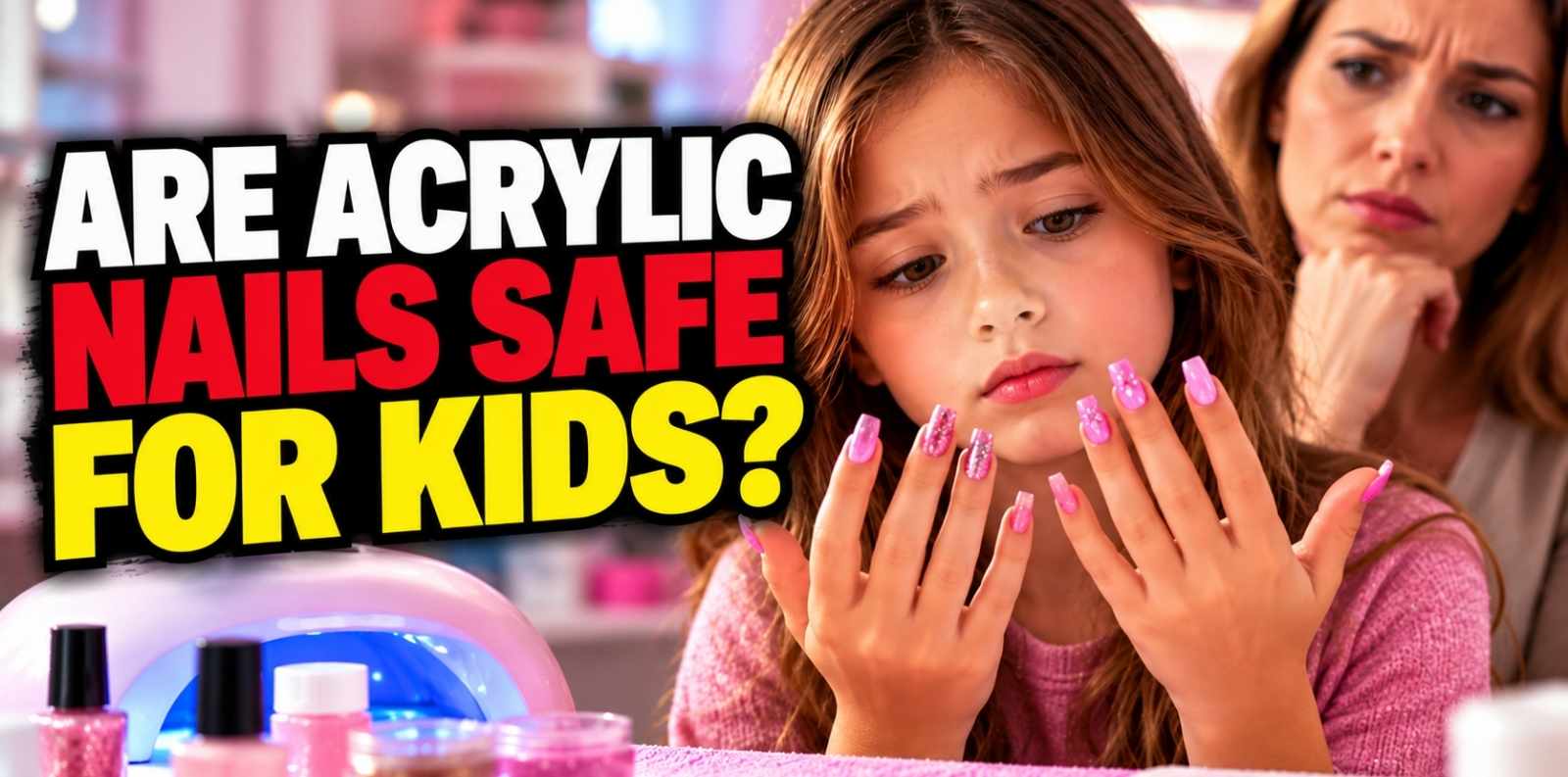
Liquid acrylic can look harmless after it hardens, but much of the risk happens before and during that transformation. A child’s small hands, quick movements, and tendency to chew, pick, or pull at nails make a standard salon manicure a poor safety choice.
The practical answer is that liquid-monomer acrylic nails are not a low-risk option for young children. There is also no universal age at which they become automatically safe. Age, behavior, product ingredients, salon conditions, application method, and removal technique all affect the risk.
The Practical Answer
For toddlers, preschool-age children, and most younger children, skip cosmetic acrylic nails. Liquid monomer, strong adhesives, nail drills, sharp tools, and bottles that are difficult to handle create too many avoidable risks.
An older teen may be more capable of leaving a manicure alone, but maturity does not remove the product risks. If an older teen still wants the look, a lower-risk plan would include:
- An experienced nail professional using a clearly identified, MMA-free system
- No direct contact between uncured product and the skin
- A clean, well-ventilated salon
- Careful application without a nail drill
- Regular adult supervision and no chewing or picking
- Professional removal rather than peeling or forceful scraping
- Immediate removal if the nail plate becomes damaged or an irritation develops
A product labeled “MMA-free,” “non-toxic,” “five-free,” or “kid-friendly” is not automatically safe. Those phrases are not proof that a child can use the product without supervision.
The FDA’s guidance for using nail products recommends following product directions, avoiding use on damaged or irritated skin, and minimizing prolonged skin contact. Those precautions matter even more when the user is a child.
What Parents Mean by “Acrylic Nails”
“Acrylic nails” can describe several products that do not have the same ingredients or risks.
A traditional system uses a liquid monomer mixed with a polymer powder. The mixture is placed on the natural nail or a tip and hardens. Traditional systems may use methyl methacrylate, commonly called MMA.
Many newer products use ethyl methacrylate, known as EMA, or other acrylate and methacrylate ingredients.
The word “acrylic” does not tell you everything you need to know about the product. Ask for the full monomer name, not merely whether the bottle says “acrylic.”
| Nail product | How it works | Main concern for children |
|---|---|---|
| Liquid acrylic overlay | Monomer and powder harden on the natural nail | Uncured methacrylate, filing, skin contact, and difficult removal |
| Full-coverage acrylic | Product is applied over the entire natural nail | More preparation and removal pressure |
| Gel or gel-acrylic hybrid | Resin is hardened under a lamp | Uncured methacrylates remain a concern; the lamp does not make every product safer |
| Dip powder | Nail is placed in powder and liquid activator | Some systems contain MMA, even though no lamp is used |
| Press-on nails | Preformed nails are attached with adhesive or glue | Less solvent exposure, but cyanoacrylate glue can irritate or bond skin |
| Regular polish | Colored coating dries by evaporation | Fewer polymerizing monomers, but age labels, solvents, and quick-dry products still matter |
MMA, EMA, and Acrylates
MMA is a central concern because it can cause irritation and allergic contact dermatitis. Repeated or prolonged exposure can also damage the natural nail. EMA and other methacrylates can cause allergic reactions too.
A product without MMA may therefore be a better choice, but it may still contain ingredients that can sensitize sensitive skin.
Most exposure occurs while the product is wet, during cleanup, or while contaminated residue remains on the skin. A fully hardened enhancement is much less likely to cause skin exposure, although filing, removal, and damaged areas still need care.
“Airy” or “low-odor” does not mean nonhazardous. The smell can change with ventilation or fragrance, while a low-odor formula can still contain a sensitizing monomer. Ventilation lowers airborne exposure, but it does not make skin contact safe.
Why “Five-Free” Does Not Answer the Question
“Five-free” is mainly a nail-polish marketing term. It usually refers to the absence of certain ingredients in a traditional polish formula. It does not establish that a full acrylic system is safe for a child.
The same applies to terms such as:
- “Non-toxic”
- “Salon formula”
- “Professional strength”
- “Eco-friendly”
- “Cruelty-free”
- “Kid-safe”
- “Dermatologist tested”
None replaces a complete ingredient disclosure. Most ordinary cosmetics, including many nail products, are not individually preapproved by the FDA before they reach stores. A company’s statement that a product is “FDA registered” also does not mean the FDA has declared the product safe or approved it.
Why a Child’s Hands Change the Risk
The same manicure can involve different risks for an adult and a child. Children move suddenly, touch their faces, chew things, and may not report burning or itching soon enough to prevent continued exposure.
Children are more likely to touch or chew the product
A child may chew a nail enhancement after it starts to lift. They may also bite off a corner, pick at the gap between the enhancement and natural nail, or pull off a nail that catches on clothing or bedding.
That behavior can expose the natural nail to saliva and bacteria. It can also tear the nail plate, create sharp edges, and damage the bed beneath the nail.
Their nails are more easily damaged
Children’s nails often feel softer or more flexible than adult nails. Some children also have existing splits, nail biting, eczema, or small cuts around the fingertips. Filing through a weak area or removing an enhancement with force can make the injury worse.
A child may also receive an extension that is simply too long. Long nails catch on toys, clothing, and sports equipment, creating a risk of trauma to the nail and finger.
Spills and hand-to-mouth behavior are harder to control
A child who does not touch the enhancement may still grab a bottle while it is open. Monomer, primer, glue, and removal liquid can spill onto a table, the child’s clothing, or nearby surfaces.
Small bottles and pump dispensers may be difficult for adults to handle safely while holding a struggling or restless child. Sitting in a salon while wearing uncured product for an hour gives a child ample time to touch it.
Early sensitization can affect later choices
Contact allergy is not the same as immediate poisoning. A person may initially tolerate a product and later develop a rash after repeated exposure. Sensitization is a concern for a child because an avoidable manicure can make future use of acrylates, adhesives, or even some wound-care products more difficult.
A child who has reacted to band-aids, nail glue, false nails, or gel enhancements may already be sensitive to related chemicals. Cosmetic nails should not be used on that child until a qualified medical professional evaluates the history.
Sensory and developmental needs matter
A child with asthma, severe allergies, eczema, sensory sensitivity, or an anxiety disorder may find the odor, waiting, or unfamiliar procedure especially difficult. A low-odor formula and shorter appointment can reduce stress, but they cannot remove the basic safety concerns.
When medical or developmental factors are involved, ask the child’s pediatrician or dermatologist rather than relying on a salon employee’s personal opinion.
The Main Safety Risks, Explained
Allergic contact dermatitis
The most important product-related concern is allergy to uncured acrylate or methacrylate ingredients. The immune system can react to a small exposure that would not bother another person.
A reaction may develop hours or days later, which makes it easy to miss the connection. Watch for:
- Redness or discoloration around the nail
- Itching, burning, or stinging
- Swelling
- Tiny blisters
- Peeling or cracking
- A rash that spreads beyond the fingertip
The area may look less dramatic at first and then worsen over several days. A child should stop wearing the product and stop applying products to the irritated skin until a clinician can assess it.
Nail-plate damage
Acrylic removal can lift the enhancement, but forceful scraping, drilling, or repeated soaking can also pull away layers of the natural nail. The same can happen if the technician removes the whole set in one long session.
A natural nail can become thin, ridged, cracked, or separated from its bed. A separating nail plate may look white, yellow, or green, especially when wet. This appearance does not always mean an infection, but it should be evaluated if it persists.
A child’s damaged nail may take a long time to grow out completely. A full set of long extensions can create the most removal risk because the thickness and length leave little healthy natural nail visible.
Nail-bed injury
Proper application should not cut the skin or force the nail plate away from its bed. However, a moving child, a dull tool, or an impatient technician can turn a minor problem into a wound.
Keep children out of the chair if the procedure requires a nail drill, electric file, heavy scraping, or repeated forceful pressure. Many adult tutorials assume the user can sit perfectly still and keep their fingers rigid.
An adult interested in the basic home application sequence should use a guide written for adult nails, not adapt it for a child. A nail drill is one of the main reasons many home applications are inappropriate for young users. A drill-free preparation method can reduce certain mechanical risks, but it does nothing to make liquid monomer safe.
Airborne fumes and salon air
The strongest smell usually comes from uncured monomer, adhesive, primer, and removal products. Sensitive children and adults may report irritation, headache, nausea, coughing, or eye watering.
Choose a salon with effective source control and local ventilation. Open doors, a single fan, or an air purifier alone may not be enough. A technician should keep open containers away from the child, close products promptly, and avoid exposing waiting children to active product work.
If a child’s eyes water, coughs, or develops a headache, the appointment should stop and the pair should leave the area. Returning is reasonable only after the salon has allowed the product to be covered and the room ventilated. Air monitoring is not usually necessary, but a skeptical parent has every right to decline a visibly unventilated setup.
Cuts from files and buffers
Nail files, buffers, nippers, and cuticle tools can cause scratches or cuts. These injuries are easier to get in a living child because the hand may move.
A professional salon should use clean tools. Files and buffers are generally discarded after each client because they can collect debris. Reusable metal implements should be sterilized through an appropriate, validated process.
Salon sanitation rules and inspection practices can vary by state and locality, so parents can ask how the salon handles them.

Similar Posts